
How to choose the right OLT port density for your ISP
Buying the densest OLT you can afford is not a strategy. Matching port count to take-up curves, POP constraints, and support reality is how Indian operators avoid stranded capital — and emergency expansions.
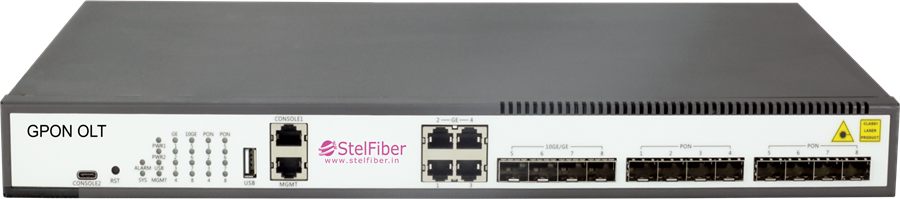
Optical Line Terminals sit at the centre of every FTTH story. Yet many purchase decisions still start with a single question — “What is the cheapest chassis?” — instead of “What density will we actually utilise in 12 months without trapping cash or stranding ports?”
StelFiber works with operators selecting compact 1- and 2-port OLTs for pilots, mid-density 4-port systems for townships, and 8-port class platforms for denser city clusters. The right answer depends on geography, sales velocity, and how you staff support.
Start with take-up, not brochure maxima
An 8-port OLT that can theoretically host a large ONU population is only valuable if your splitter trees, sales pipeline, and install capacity fill those ports on a predictable timeline. Model:
- Homes passed vs expected take-up by quarter
- Average ONUs per PON after split ratio and loss budget
- Seasonal install capacity (teams, permissions, materials)
- Spare-port headroom for churn, VIP adds, and contingency
If your next 12 months of realistic adds fit a 2- or 4-port envelope with headroom, overbuying density often means paying for idle optics, power, and rack space.
When compact OLTs win
1-port and 2-port GPON OLTs excel for:
- Greenfield pilots and society trials
- Remote POPs where power and space are constrained
- Edge aggregation close to a small cluster of buildings
- Operators validating processes before a denser chassis wave
Compact units reduce the cost of learning. They also force cleaner optical discipline — every port matters, so technicians cannot hide weak plant behind unused capacity.
When 4- and 8-port platforms make sense
Mid and higher density OLTs earn their keep when you already have:
- Proven sales motion in a defined territory
- Stable install crews and spare ONU stock
- Uplink and aggregation ready for concurrent streaming peaks
- A POP with reliable power, cooling, and physical security
At that stage, fewer chassis with more PON ports usually simplify monitoring, firmware baselines, and spare strategy — provided you do not oversubscribe blindly.
EPON vs GPON is a network decision
Some operators standardise on EPON because of existing ONU fleets or partner ecosystems. Others prefer GPON for broader modern FTTH tooling. Mixing standards without a clear migration plan creates training and spare-parts friction. Choose the optical standard first; then select port density inside that family.
Uplinks, power, and the unglamorous checklist
Port count is only half the OLT. Confirm uplink options (GE / 10GE class as needed), dual-power readiness where available, management access, and alarm behaviour your NOC understands. A dense OLT with fragile power or unclear management becomes a single point of customer pain.
A simple selection rule
Pick the smallest OLT class that covers your next 12–18 months of credible demand with 20–30% headroom — then document the upgrade trigger (subscriber count, port utilisation, or new territory). That keeps capital working and expansions intentional.
Explore StelFiber’s OLT lineup — from STGP01X / STGP02X compact units to 4- and 8-port GPON and EPON options — or talk to sales with your homes-passed and take-up assumptions for a practical shortlist.